
Sunlight Readable Panel PC
Sunlight readable panel PCs solve this with ultra-high-brightness displays, so operators can read and use the screen in strong ambient light.
Our range from Cincoze combines a bright display with a complete industrial computer in one unit. Sizes run from 8.4" to 24", with brightness up to 1,800 nits, rugged aluminium front bezels, IP65-compliant front panels and operating temperatures from -20 °C to 70 °C on most models.
Flexible mounting (panel, VESA and rack) and modular expansion make the panel PCs a good fit for outdoor kiosks, vehicles, transportation and industrial HMI.

Showing 7 products

12.1" Cincoze CS-112H / P2102 Series Sunlight Readable Panel PC
12.1″ TFT-LCD Modular Panel PC with 8th Gen. Intel® Core™ U Series Processor

15" Cincoze CS-115 / P2102 Series Sunlight Readable PC
15″ TFT-LCD Sunlight Readable and Modular Panel PC with 8th Gen. Intel® Core™ U Series Processor

17" Cincoze CS-117 / P2102 Series Sunlight Readable Panel PC
17″ TFT-LCD Sunlight Readable and Modular Panel PC with 8th Gen. Intel® Core™ U Series Processor

21.5" Cincoze CS-W121 / P2102 Series Sunlight Readable Panel PC
21.5″ TFT-LCD Sunlight Readable and Modular Panel PC with 8th Gen. Intel® Core™ U Series Processor

24" Cincoze CS-W124 / P2102 Series Sunlight Readable Panel PC
24″ TFT-LCD Sunlight Readable and Modular Panel PC with 8th Gen. Intel® Core™ U Series Processor

19" Cincoze CS-119/P1001 Sunlight Readable Panel PC
19″ TFT-LCD Sunlight Readable Touch Panel PC with Intel® Atom™ E3845 Quad Core Processor

8.4" Cincoze CS-108 / P1301 Series Sunlight Readable Panel PC
Sunlight Readable Panel PC
Brightness levels explained
A nit (cd/m²) measures how much light a display emits per square metre. The higher the number, the brighter the screen.
Up to about 500 nits Standard indoor screens and standard industrial panel PCs. They are clear in normal indoor light, but not suitable for locations exposed to the sun.
500 to 1,000 nits For bright indoor areas and for shaded or semi-outdoor locations. This is a good step up for windowed halls, canopies and covered kiosks, although these screens can still struggle in direct sun.
1,000 to 1,500 nits, Suited to outdoor use with partial or changing sunlight. They are readable in most daylight conditions, including bright outdoor environments.
At 1,500 nits and above, displays are designed for direct sunlight, vehicles with large windows and open outdoor installations. They are built to stay readable in the strongest ambient light.
These ranges are rules of thumb. Real results depend on the installation, the angle to the sun, coatings and the content shown.
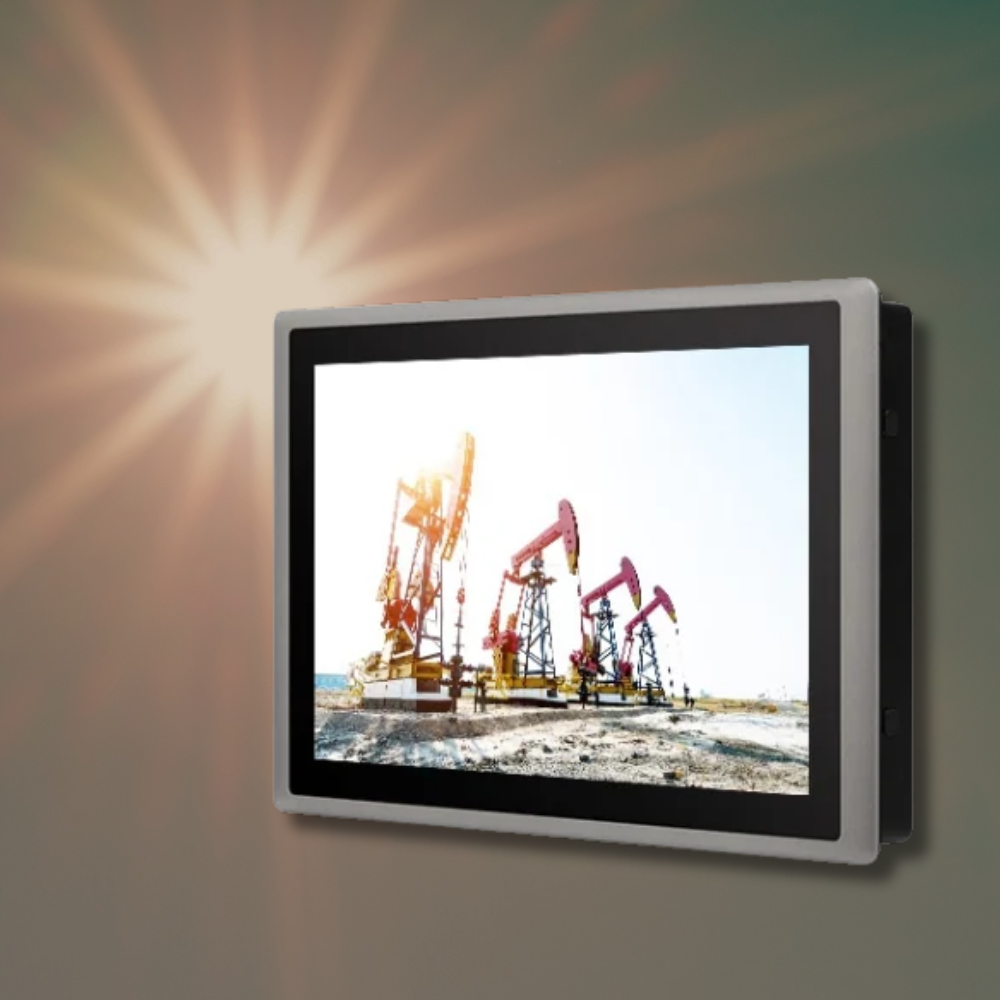
When do you need a sunlight readable panel PC?
A sunlight readable display is needed when the light around the screen is stronger than a standard display can overcome. A screen does not only have to emit light, it has to compete with the light that falls on it and reflects off its surface. When that reflected light approaches the brightness of the image itself, contrast collapses, colours fade and the content looks washed out. Pushing up the backlight on a standard screen rarely fixes this, because it is not built to be bright enough in the first place.
It’s not just about sunlight and outdoors installations
The key question is therefore not whether the installation is outdoors, but how much light reaches the screen at its worst moment. A screen in the open under a clear sky is the obvious case, but strong light also reaches screens that are nominally indoors, through large windows, skylights or open doors, and through powerful lighting aimed across a room.
What makes it difficult is that the light changes. The angle of the sun shifts through the day and the year, the weather varies, and a vehicle or machine turns the screen in new directions. A display that looks fine in the morning can be unreadable at noon, so it must be chosen for the brightest conditions it will ever meet, not the average ones.
The second factor is how much depends on being able to read the screen. When the display is a convenience, a washed-out image is an annoyance. When it is the interface of a payment terminal, the control screen of a machine or a source of information an operator must read at a glance, an unreadable screen means failed transactions, slower work and, in some cases, safety risks. The more critical the screen is to the task, the less margin you can afford to give away.
Sunlight readable displays are also designed with more in mind than brightness. Anti-glare treatment, true-flat fronts and good contrast reduce reflections, and the surrounding hardware must handle the conditions that usually come with strong light, such as heat, dust and moisture. A bright backlight produces more heat, so the system has to cope with higher temperatures and still run reliably.
If the screen sits in a controlled indoor environment with steady, moderate lighting, a standard industrial panel PC is usually the more economical and sensible choice. As soon as sunlight, glare or changing light can reach the screen, and the screen matters to the work being done, a sunlight readable panel PC is the safer investment.
Q&A about Sunlight Readable PanelPC
Sunlight-readable Panel PCs combine high-brightness LCD panels with technologies such as optical bonding, anti-reflective (AR) coatings and anti-glare (AG) surface treatments. While increased backlight brightness improves visibility, reducing surface and internal reflections is equally important for maintaining contrast and image clarity. The combination of these technologies determines how effectively a display performs under direct sunlight.
High-brightness Panel PCs feature increased backlight luminance, typically ranging from 700 to 2,000 nits or higher. However, high brightness alone does not guarantee sunlight readability. Sunlight-readable Panel PCs also incorporate technologies that reduce reflections and improve ambient contrast. A properly optimized sunlight-readable display can therefore offer better outdoor visibility than a conventional high-brightness display with higher luminance.
Optical bonding eliminates the air gap between the LCD panel and the touchscreen or protective cover glass using an optically clear adhesive. This reduces internal reflections caused by differences in refractive indices, resulting in improved contrast and sunlight readability. Optical bonding can also reduce internal condensation and improve mechanical resistance to shock and vibration.
High-brightness LCD backlights generally require more electrical power and generate additional heat. Combined with direct solar radiation, this can increase internal operating temperatures and affect component lifespan.
Effective thermal management through heat dissipation, passive cooling and automatic brightness adjustment helps maintain system reliability.
The operating temperature range of the LCD panel, processor and other electronic components must also be considered when designing outdoor computing systems.
Key technical specifications include display luminance (cd/m²), ambient contrast ratio, surface reflectance, viewing angles, operating temperature range and touchscreen performance.
For outdoor installations, ingress protection (IP rating), UV resistance, solar radiation tolerance and resistance to temperature fluctuations should also be evaluated. Automatic brightness control and suitable thermal management are particularly important for applications exposed to varying lighting and environmental condition
Need a Panel PC That Performs in Direct Sunlight?
With our range of Cincoze sunlight readable Panel PCs, we can help you find the right solution based on your requirements for display brightness, computing performance, environmental protection and system integration.
Contact our experts to discuss your application and find the right standard or customized Panel PC solution for your project.